The short answer
Use AI for the research and the drafts, and keep the decisions. Have it study your competitors and their bad reviews, find the position no one owns, draft several options and a SWOT, then build the website. You choose the position, check every fact and test every form. That's how we repositioned my brother's pool company.
Three takeaways
- AI researches, you decide. It studied competitors and their reviews. Dan and I made the call.
- Find the position no one owns. Cross off any line a competitor could also say.
- Check everything. Facts, forms and privacy settings, every time.
Full disclosure first: Dan Huber is my younger brother. He owns Wild West Custom Pools in the Austin area. I'm telling the story because he's comfortable letting us show all of it: the decisions, the work and the results as they come in, good or bad.
This is how we repositioned a pool builder with AI. The website was the smallest part.
How do you know your business needs to reposition?
When you're winning the wrong buyers, and your message could belong to any competitor. Dan had been running Wild West as a general-market pool builder. He was getting buyers at the low end of the market, and they wanted discounts and deals on top of already thin margins.
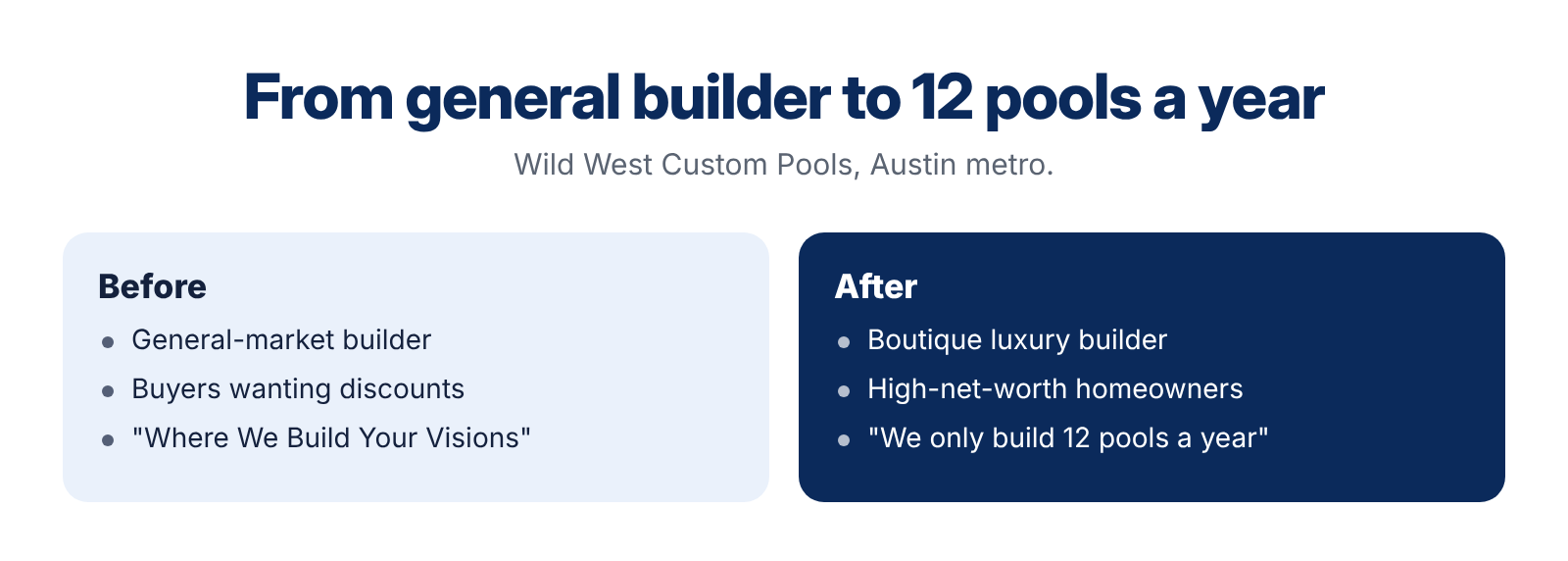
Over several conversations, I challenged him on who he was chasing: the buyer who had to finance a pool, rather than the client who could write a check. He decided to change course: Wild West Custom Pools would become a boutique luxury pool builder for high-net-worth homeowners in Austin, Round Rock, Pflugerville, Hutto, Cedar Park and Leander.
The raw material was strong. Dan is a hands-on owner and builder, with five years building pools. He partners with a separate designer who has more than 20 years of custom pool design experience. Projects run from $90,000 to more than $350,000.
But his message didn't show any of that. His website was a WordPress template with a stock pool photo and the headline "Where We Build Your Visions." It worked. People could see he had an active business. But you could tell it was a template, and he described himself in words any competitor could use.
How can AI help with competitor research?
AI can read how every competitor in your market positions itself, and what their customers complain about, far faster than you can. The whole project ran through Claude in Cowork. It started with one prompt: the owners want to move from being a general pool builder to a boutique builder doing only 10 to 12 pools a year for high-net-worth clients. Look at the competitors and come up with a website that generates leads.
AI researched how Austin-area builders positioned themselves. Most emphasized scale, used generic "quality craftsmanship" language and never mentioned the owner. It also studied boutique builders in other markets, and found they had scarcity, personal service and the client relationship in common.
Its key finding: no competitor owned the "owner on-site, only 12 pools a year" angle.
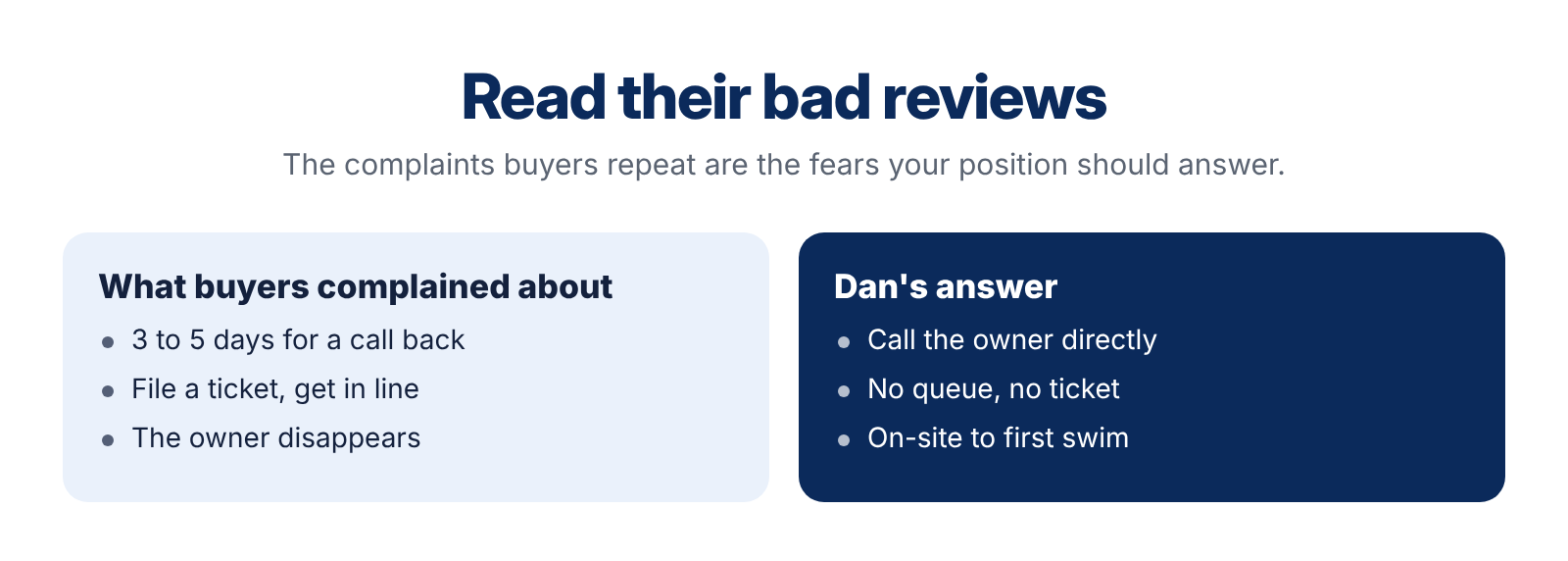
Then we read the big builders' negative reviews. The same complaints came up over and over. You wait three, four, five days for a call back. You file a ticket and get in line. The owner disappears once the contract is signed. In most cases you never meet the owner at all.
So we positioned Dan 180 degrees from that.
How do you test positioning options with AI?
Have AI draft several, then cross off any line a competitor could also say. AI drafted five positioning options. "Quality craftsmanship" fell away fast, because every builder says it. "Austin luxury pool specialist" was still generic. "20 years of design experience" was true, but not ownable.
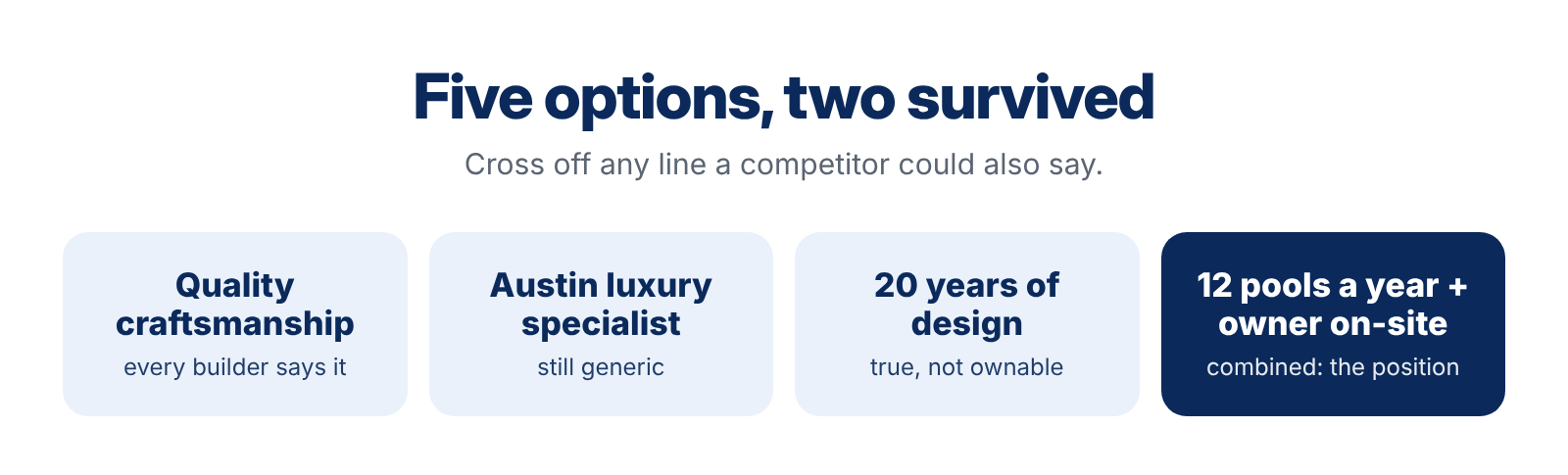
Two survived, and we combined them: "We only build 12 pools a year, because every one of them deserves the owner's full attention, from excavation to first swim." You get Dan's phone number. No queue, no ticket.
AI did the research and drafted the options. Dan and I made the call.
From there, AI drafted a SWOT, we refined it with what we knew about the business, and AI built the first complete website in less than a workday. Then came nine rounds of review and revision. That's where people mattered most.
What does AI get wrong when you reposition a brand?
Facts, small wording and the technical details nobody demos. AI's first draft said Dan personally designs every pool. He doesn't; he works with a dedicated designer. Small wording mattered too. "Every day" became "every step of the way." "Final swim" became "first swim."
The contact form took about seven rounds of troubleshooting before every inquiry reliably reached Dan's inbox. After launch, a review found server log files with visitors' personal information that were publicly accessible. They were deleted. When spam started arriving, invisible spam protection was added.
Even Dan's headshot changed. His photo showed him in a New York Yankees cap, and an AI image tool, ChatGPT in this case, swapped it for a Stetson that fits a Texas brand. If you edit photos of real people with AI, get their consent first.
Last, AI drafted an ad playbook for a $500 to $1,000 monthly budget: Google Business Profile first, Google Search ads as the main paid channel, Facebook and Instagram second.
What were the results?
It's too early to report lead results. The site launched in June 2026, and I won't pretend otherwise. A custom pool that starts at $90,000 is a long, careful decision.
The best news so far isn't a number. Dan is running it himself now. He's added a pricing tool, city pages and a better lead system on his own. Clear destination, and he took the wheel.
How can you reposition your own business this week?
Start with your competitors' bad reviews and a clear list of who you're not for. Here are five lessons you can use.
1. Read your competitors' bad reviews. Not their websites. Their reviews. The complaints buyers repeat are the fears your position should answer. Ask AI to sort them into themes, then check its work against the reviews themselves.
2. Write down your "no." "Twelve pools a year" works because it turns most buyers away. It tells the right buyer they won't be one of 40 jobs. Who are you not for? Saying no to most buyers is what made the right ones say yes.
3. Test positions before you write copy. List five ways you could describe your business. Cross off anything a competitor could also say. What's left is worth testing.
4. Turn your research into a SWOT, then add what only you know. AI can draft one from the research. You know which strengths are real. The free SWOT tool walks you through five items in each quadrant, and how you know each one.
5. Have a person check every fact, every form and every privacy setting. AI builds fast, but it isn't fact-checked and it doesn't test your inbox. Submit your own form. Then submit it again from your phone.
Once a new site is live, the next win is usually in search. Here's how to find striking distance keywords, the pages that are close to page one and need a push.
Try this: Sort your competitors' bad reviews
Copy this into ChatGPT, Claude or Gemini. Replace the [brackets] first.
Context: My business: [what we sell, where]. My top competitors: [names]. Their negative reviews: [paste 20 or more].

Role: Act as a positioning strategist.

Ask: Sort the complaints into themes, then suggest positions that answer the biggest fears and that no competitor could also claim.

Format: A table of themes with how often each appears and a sample quote, then five positioning lines with why each is ownable.

Tighten: Use only the reviews I pasted. Don't invent facts about my business; I'll check every theme against the reviews themselves.

Before you start, ask me any questions you need answered, and suggest ideas I may have missed.
Then use the free SWOT tool.
“Saying no to most buyers is what made the right ones say yes.”
— Mike Huber
Where does a good position come from?
Usually from how you already work. Dan's position didn't come from AI. It came from how he already worked: a hands-on owner who limits how many pools he builds. AI helped us see it, test it and say it clearly.
FAQ
Can AI choose my brand position for me?
No. AI can research competitors, draft options and point out gaps, but you decide. For Dan's company, AI drafted five options, and Dan and I picked and combined two.
What should I ask AI to research before repositioning?
Ask how competitors in your market describe themselves and what their negative reviews say. Then ask what no one owns. Check its findings against the sources themselves.
How long does it take to reposition a business with AI?
For Dan's company, AI built the first complete website in less than a workday. Then came nine rounds of review and revision, which is where most of the time went. [Mike: total time from first prompt to launch?]
Do I need a new website to reposition?
Your website has to say the new position, but the position comes first. In Dan's case, the website was the smallest part of the work.
Your next three actions
- Read twenty of your competitors' negative reviews and note the complaints that repeat.
- List five ways to describe your business and cross off any a competitor could also say.
- Turn what's left into a SWOT with the free SWOT tool.
If you'd like a quick read on your own marketing, take the free five-minute audit. You'll get a score for each of the ten core disciplines and your top three fixes.