
The short answer
AI can cut the time a small marketing team spends on writing, editing and checking by weeks, not minutes. Studies show tasks done 25% to 40% faster. On our book, the first edition took about six months and the second reached an edited final draft in about six weeks. The bigger gain was fewer errors, and people still approve everything.
Three takeaways
- Weeks, not minutes. The first edition took about six months. The second took about six weeks.
- Quality was the surprise. AI caught errors five people missed. People still approve everything.
- Start with one workflow. One recurring task, one saved prompt, one person who approves.
In 2023, Loren Ankarlo and I published Business Transformation Through Digital Marketing. This fall we built the second edition, Business Transformation Through AI-Powered Marketing.
Six months vs. six weeks. That's the headline, and it's real. But speed isn't the part of building marketing with AI that changed my mind. I'll get to that.
How did one email turn into a new way of working?
It started small: one document, then a website, then a whole business. On Friday, September 25, 2026, I got an email. The team that produces Boehringer Ingelheim's on-demand continuing-education courses wanted to publish a video of a talk I gave in Las Vegas, Veterinarians and Video. To push it live, they needed my current CV.
I hadn't updated it in a couple of years. So I gave Claude my old résumé, told it what I'd done since, and had a CV I was proud to send in less than an hour.
Then the CV didn't match my website. So I rebuilt mikehuber.com, in under two hours.
Then my brother Dan called. He owns Wild West Custom Pools in the Austin area, and his business was stalling. One conversation turned into a new position for his company, a new marketing plan and a new website.
A CV, a website, my brother's business. Each one bigger than the last. That got me thinking about the book.
Why does marketing work take so long without AI?
Most of the time goes to waiting. Work moves from one specialist to the next, and each step waits for the one before it.
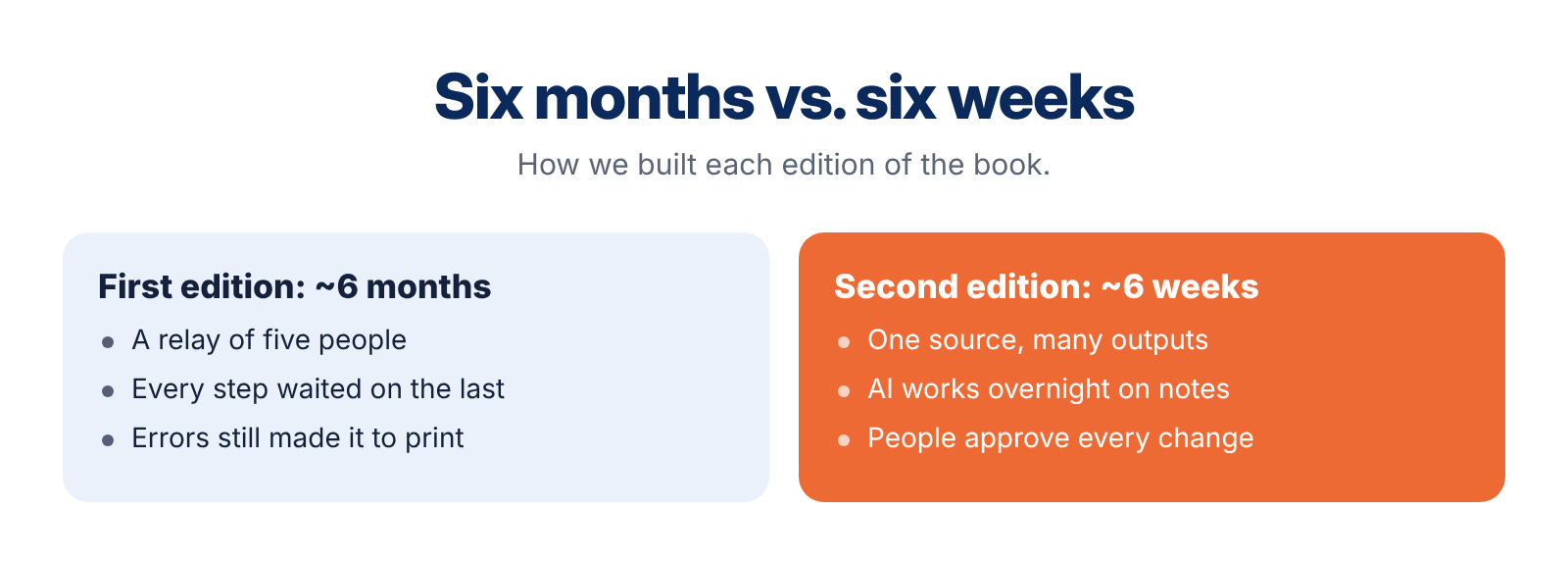
Here's how we built the first edition. Loren and I wrote it. Three editors and proofreaders went through it, one after another. I laid out the whole thing myself in Adobe InDesign, a program I was new to, and every edit meant reflowing pages by hand. We paid an editor $1,000, bought stock graphics and formatted it three ways.
Five people touched that first draft. Every step waited for the one before it. Editing waited on writing. Design waited on editing. That's how most agencies and marketing departments still work: a relay race of specialists.
And here's the part that stings. After all those people and all those passes, the errors were still in print. When we ran the first edition through AI, it found typos like "Putttting" and "aready." It found a keyword worksheet showing a ".02%" opportunity that should have said 2%. It found score bands that ran to 400 on a grid that maxed out at 300.
Nobody saw them, because no person reads 170 pages the way a checker does. We found them two years after the book was printed.
What does an AI marketing workflow look like?
One source, many outputs, and a person approving each step. For the second edition, the book stopped being the product. It became the source. From it we built field guides for each skill, a website with a page for every chapter, online tools, workbooks and workshop kits. Change a chapter, and the pieces built from it can be rebuilt from the same source.
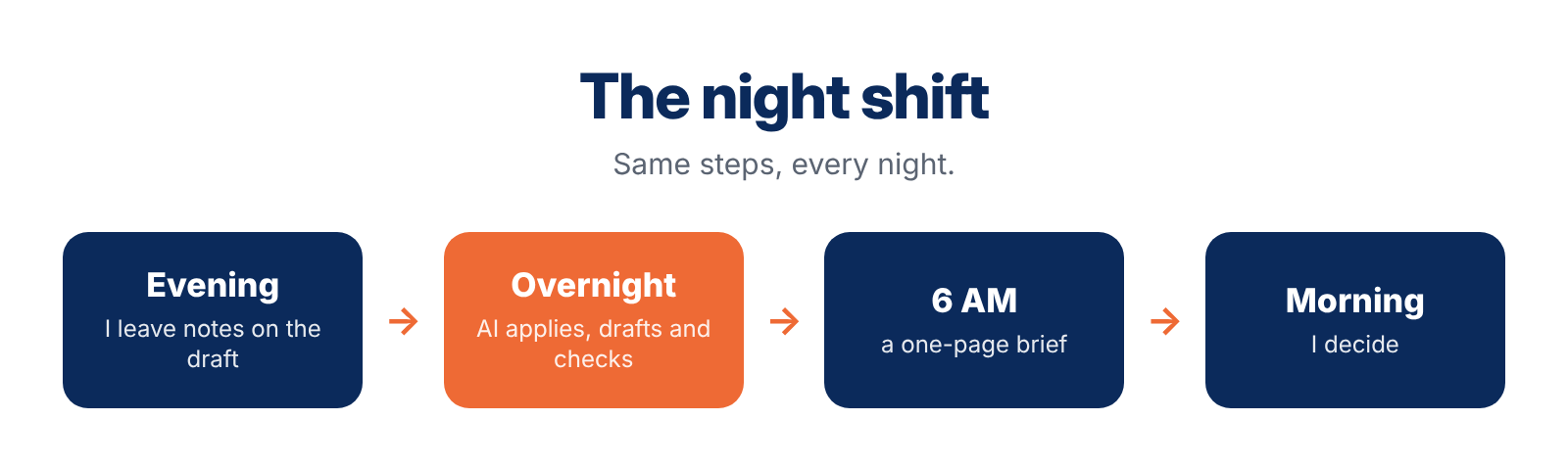
The part people don't believe until they see it is the night shift. In the evening I read the draft and leave sticky notes on the PDF, the same way I'd mark up a printout. Overnight, AI reads every note, makes the clear changes, drafts the bigger ones for my approval and runs the checks. At 6 AM I get a one-page brief: what it did, what it needs from me and how far we are from done.
It has hard rules. It never publishes. It never sends anything. It never makes up a fact. If it isn't sure, it asks.
Does AI make marketing work better, or just faster?
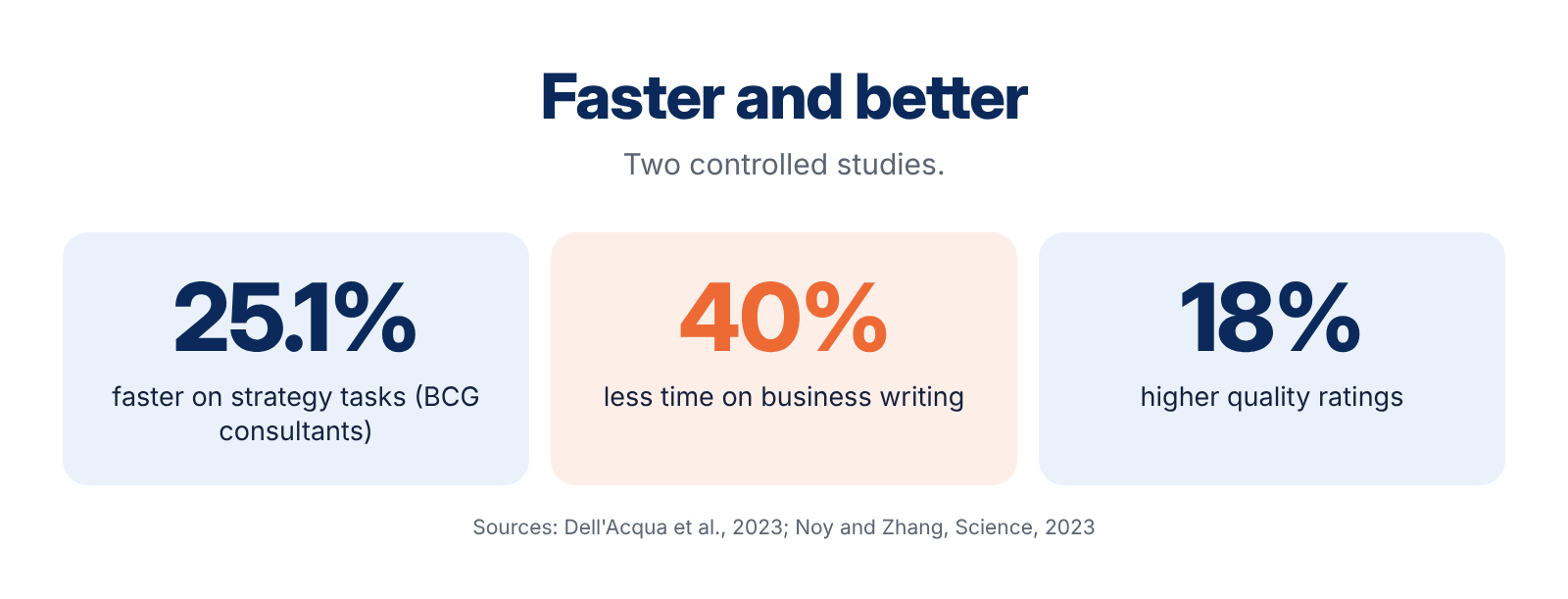
Both, if a person checks the work. The research backs up the speed. In a Harvard Business School study, BCG consultants using AI finished strategy tasks 25.1% faster (Dell'Acqua et al., 2023). In a study published in Science, professionals took 40% less time on business writing, and the work was rated 18% higher in quality (Noy and Zhang, 2023).
But the thing that surprised me most was quality. Every chapter and page reference checked. Every score band recalculated. Every statistic matched to a current source. AI finds the problem. A person decides what to do about it. And unlike a person, it doesn't get tired at page 400.
What didn't change: people own the work. Every piece still waits for a person to read it and say yes.
“AI finds the problem. A person decides what to do about it.”
— Mike Huber
How can a small team start saving time with AI?
Start with one recurring task, one saved prompt and one person who approves. You don't need my setup to get most of this. Here's what I'd start with.
1. Think first, on paper. Our loop is simple: you think, AI drafts, you decide. Write down your goal, your customer and the facts only you know before you open the AI. If you need a place to start, fit your whole marketing strategy on one page. That page is the best context you'll ever give an AI tool.
2. Write every prompt with CRAFT, then save it. Context, Role, Ask, Format, Tighten. Give it your business and your facts, tell it who to be, give it one job, say what you want back and set the rules. Then save the prompt where your team can find it. A prompt you save and share is a process. A prompt you retype is a habit.
3. Use AI to check, not just to draft. Most people stop at first drafts. Ask it to find errors in work you've already published: broken math, wrong references, terms used two different ways. That's where it caught what five people missed on our book.
4. Give it hard rules. Never publish. Never send. Never invent a fact. Flag anything you aren't sure of. Write those rules down once, so they apply to every task.
5. Build one workflow, not ten. Pick one thing your team makes every month: the report, the blog post, the ad set. Time it the way you do it today. Write one CRAFT prompt for it, name the person who approves every draft, then time it again. When the team sees its own before and after, you don't have to sell them on it.
Try this: Use AI to check work you've already published
Copy this into ChatGPT, Claude or Gemini. Replace the [brackets] first.
Context: Here is a piece we've already published: [paste the page, report or guide]. The facts it should match: [paste prices, dates, names or source figures].

Role: Act as a careful copy editor and fact checker.

Ask: Find errors: broken math, wrong references, outdated facts, typos and terms used two different ways.

Format: A table: where it is, what's wrong, the suggested fix and how sure you are (high, medium, low).

Tighten: Don't rewrite the piece. Don't invent facts; if you can't check something, say so.

Before you start, ask me any questions you need answered, and suggest ideas I may have missed.
Then use the free AI Tip Prompt Library.
What skill matters most when you work with AI?
Knowing what good looks like. I expected the hard part to be learning the tools. It wasn't. Using AI is mostly typing in plain English. The skill that mattered was knowing which draft is wrong, which claim needs a source, what a customer will actually read. That came from 25 years of doing the work.
Your team has that kind of experience, too. AI needs it from them.
FAQ
How much faster is marketing work with AI?
In published studies, people finished tasks 25% to 40% faster with AI (Dell'Acqua et al., 2023; Noy and Zhang, 2023). On our book, the project went from about six months to an edited final draft in about six weeks.
Which marketing tasks should a small team give to AI first?
Start with something your team makes every month, like a report, a blog post or an ad set. Time it before and after, so you can see the change.
Can AI check marketing work for errors?
Yes. Ask it to look for broken math, wrong references and terms used two different ways. On our first edition, it found typos and scoring errors that five people missed.
Does AI replace the people who approve the work?
No. In our workflow, AI never publishes, never sends and never invents a fact. Every piece waits for a person to read it and say yes.
Your next three actions
- Pick one thing your team makes every month and time it.
- Write one CRAFT prompt for it with hard rules: never publish, never send, never invent a fact.
- Run an AI error check on one page you've already published.
The free CRAFT template, the AI fluency ladder and the rest of the book's tools are in the free resource library. Use them. They're already built.
If you'd like help building that first workflow with your own team, on your own work, take a look at how I run training. It starts with where your team is today.